Neither method wins every case. Snaking often clears simple, local clogs quickly. Hydro jetting can remove broader buildup along the pipe wall in structurally sound lines. The right choice depends on the blockage, pipe condition, and a professional evaluation of the line.
Homeowners facing a slow drain or a recurring clog usually land on the same question: hydro jetting or snaking? Both are common professional drain-cleaning methods, and both can restore water flow. They don’t work the same way, though, and they aren’t suited to the same problems. This article walks through how each method works, what kinds of clogs each one handles well, and how pipe condition shapes which option makes sense. You’ll also see where the two methods overlap, where they differ, and when neither one is the right answer at all.
What Is Drain Snaking?
Drain snaking, sometimes called augering, uses a flexible cable fed into a pipe through an access point. The cable has a tip, often a coil or hook shape, on the end.
As the cable moves through the line, it can break through a blockage, create a path through buildup, or catch onto certain objects and pull them back out. With the right attachment, a cable can also cut through limited root growth inside a pipe.
Snaking is a reliable way to restore water flow. It’s worth knowing that a cable mainly clears a path through the clog. It may leave some material coating the pipe wall rather than removing it completely.
What Is Hydro Jetting?
Hydro jetting sends water through a flexible hose fitted with a specialized nozzle. A plumber feeds the hose into the line through a cleanout or other access point.
As the hose moves forward, the water jets can break through suitable blockages, flush loose debris toward an access point, and clean grease, sludge, and similar buildup from the pipe wall. Because the jets work along more of the pipe’s interior surface, hydro jetting can clean a longer section of the line in a single pass than a cable typically does.
Results still depend on several things working together: access to the line, the pipe’s condition, the nozzle chosen, the pressure and flow settings, and the operator’s skill. Hydro jetting doesn’t make every pipe look brand new, especially if the line has other issues besides surface buildup.
Hydro Jetting vs. Snaking: The Main Difference
The core difference comes down to how each method interacts with the pipe.
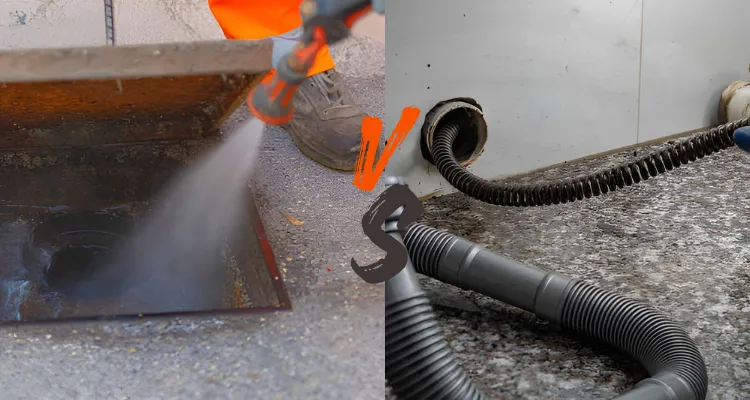
Snaking relies mainly on mechanical contact between a cable and the blockage. Hydro jetting relies on controlled water pressure and flow moving through the line. Snaking tends to open a pathway through a clog. Hydro jetting tends to remove buildup from a broader area of the pipe wall.
Neither method repairs structural damage. Clearing a blockage, by either method, restores flow. It doesn’t mean a crack, a collapse, or a separated joint has been fixed.
Quick Comparison
| Factor | Drain Snaking | Hydro Jetting |
|---|---|---|
| How it works | A flexible cable with a cutting or retrieving tip is fed through the pipe to break up or pull out a blockage | A hose with a specialized nozzle sends pressurized water through the line to break apart and flush buildup |
| Best suited for | Simple, localized clogs close to an access point | Broader buildup, grease, sludge, scale, or recurring clogs in a sound pipe |
| Grease removal | May push through soft grease but often leaves residue behind | May break apart and flush grease from a longer section of pipe wall |
| Hair-clog removal | Often effective for hair caught near a fixture or trap | Can work, but is often more cleaning power than a simple hair clog needs |
| Root removal | A root-cutting head can cut through limited root growth | A suitable nozzle can cut and flush some root growth from the line |
| Pipe-wall cleaning | Mainly opens a pathway, may leave buildup on the walls | Can clean more of the interior pipe wall in a suitable line |
| Old-pipe considerations | Can still cause damage with the wrong cable or excessive force | Can worsen existing damage without proper pressure and nozzle selection |
| Inspection needs | Helpful for repeat clogs or unknown blockages | Often recommended for older, unknown, or previously damaged lines |
| Access needs | Works through most standard cleanout or fixture access points | Needs a cleanout or access point suited to the hose and nozzle |
| Water use | Uses little to no water during the process itself | Uses a controlled volume of water to clean and flush the line |
| Typical service complexity | Generally quicker to set up and perform | Often involves more setup, equipment, and time |
| Main limitation | May not remove all wall buildup, so clogs can return | Not suitable for pipes with unresolved structural damage |
Which Method Is Better for a Simple Clog?
Snaking is often the right fit for a straightforward, local clog. This includes a single-fixture blockage, hair caught near a bathroom drain, a clogged toilet, a small paper clog, a foreign object within reach, or a blockage that hasn’t come back before.
The right size and type of cable or auger depends on the fixture and the line involved. A small hand auger suits a sink or tub, while a larger cable machine handles bigger drains. Powered cable machines call for training to use safely, since they can cause harm if handled incorrectly.
Which Method Is Better for Grease and Sludge?
Hydro jetting can clean grease, sludge, and other soft buildup from a longer stretch of pipe wall than snaking typically reaches. Heavy grease may need more than one controlled pass to clear fully.
Pipes with existing damage still call for caution, regardless of how much grease is present. Grease can return over time if the habits that caused it, like pouring grease down a drain, continue. And a blocked or partly collapsed line may not be a good candidate for jetting until it’s repaired.
Which Method Is Better for Hair and Soap Buildup?
A cable can often clear a hair clog quickly when it’s caught near the fixture. This makes snaking a practical first step for bathroom sinks, tubs, and showers.
Hydro jetting becomes more useful when hair, soap residue, and similar buildup coat a longer section of a suitable line rather than sitting in one spot. Fixture strainers and regular cleaning habits can reduce how often this kind of buildup returns, regardless of which cleaning method is used.
Which Method Is Better for Tree Roots?
Both methods can address root problems, though not always the same way. A cable machine fitted with a root-cutting head can cut through roots inside the line. Hydro jetting with a suitable nozzle can also cut and flush some root growth.
Heavy or dense root masses may need specialized cutting equipment beyond what either basic method offers. Roots typically enter a pipe through an existing crack or a joint that has already failed, so removing the roots doesn’t repair that entry point. Because the opening usually remains, roots can grow back until the damaged section gets repaired.
Which Method Cleans More of the Pipe?
Hydro jetting generally cleans more of the pipe’s interior surface than basic snaking. How much more depends on the pipe’s diameter, its condition, the type of buildup, the nozzle used, the water flow and pressure, how accessible the line is, and how many passes the job requires.
Snaking still has its place. When the goal is simply to open a blockage rather than clean the whole pipe wall, a cable machine may be the more practical and cost-effective choice.
Which Method Is Safer for Old Pipes?
Pipe age alone doesn’t determine which method is safer. What matters more is the pipe’s actual condition: corrosion, wall thickness, existing cracks, joint movement, deformation, past repairs, the specific material, and overall structural health.
Snaking isn’t automatically gentle. The wrong cable size, an unsuitable cutting head, or too much force can still damage a weak pipe. Hydro jetting isn’t automatically risky for old pipes either, but it can worsen existing damage if the pressure, flow, or nozzle doesn’t match the line. Both methods depend on matching the right equipment and technique to the pipe in front of the plumber.
Can Hydro Jetting Damage Pipes?
Professionally controlled hydro jetting is generally suitable for pipes that are structurally sound. Risk increases under certain conditions: cracked pipes, thin pipe walls, separated joints, a collapsed section, badly deformed Orangeburg pipe, broken clay pipe, an unsuitable nozzle, incorrect pressure or flow, or structural damage that wasn’t identified before cleaning began.
Cleaning the inside of a pipe doesn’t fix damage that’s already there. If a pipe has a crack or a weak wall, water pressure can expose that weakness or make it more obvious.
Can Snaking Damage Pipes?
Cable machines can also cause problems under certain conditions. These include using the wrong cable size for the line, choosing an unsuitable cutting head, applying too much force, a cable becoming stuck partway through the pipe, badly corroded pipe walls, a separated joint, entering a fragile fixture trap incorrectly, or mistaking a collapsed section for a simple clog and continuing to push against it.
Drain snakes aren’t risk-free just because they don’t use high water pressure. Mechanical force against a weak pipe can still cause real damage.
Is a Camera Inspection Needed First?
A sewer camera inspection can be a useful step in several situations: a clog that keeps returning, an older pipe, an unknown pipe material, suspected root activity, possible structural damage, a line with a past repair, multiple drains backing up at once, hydro jetting being considered, or an unclear blockage location.
A camera has limits. It may not see clearly through a complete blockage, heavy grease, or standing dirty water. In these cases, some limited cleaning may need to happen before a clear view is possible. Camera inspection isn’t required for every drain-cleaning job, but it becomes more valuable as uncertainty about the pipe grows.
When Hydro Jetting May Be the Better Choice
Hydro jetting may be worth considering when grease coats the pipe wall, sludge has built up over time, mineral or rust scale is narrowing the line, soft debris extends through a long section of pipe, roots need cutting and flushing, clogs keep returning after basic snaking, a commercial kitchen line needs a deeper clean, the pipe is structurally suitable for the process, and proper cleanout access is available.
When Snaking May Be the Better Choice
Snaking may be the better fit when the blockage is simple and local, hair is caught close to the fixture, a toilet is clogged, a foreign object may need to be retrieved, only limited cleaning is needed, water use needs to stay minimal, the pipe calls for a cautious first approach, hydro jetting access isn’t available, or a diagnostic opening is needed before a camera inspection can happen.
When Neither Method Will Solve the Problem
Cleaning, by either method, won’t fix certain underlying problems. These include a collapsed pipe, a severe belly (a sunken section that holds standing water), a broken sewer line, a missing section of pipe, a badly separated joint, severe Orangeburg deformation, a solid construction obstruction, poor pipe slope, a damaged connection, or a recurring root-entry point.
In these situations, the line typically needs repair, lining, rerouting, sectional replacement, or full replacement. The right repair approach depends on the specific damage, and no single method fits every condition.
Hydro Jetting vs. Snaking for Different Pipe Materials
PVC and ABS
Both methods can be suitable for sound plastic piping when the equipment is matched correctly to the job. Cracks, poor joints, and inadequate support all raise the risk, regardless of which method is used.
Cast Iron
Cast-iron pipe can contain rust, corrosion, mineral scale, thin sections, and rough interior surfaces, especially in older lines. Both snaking and hydro jetting call for a proper assessment before cleaning an aging cast-iron line.
Clay Pipe
Clay pipe can remain usable for a long time, but it may crack or separate at its joints as the surrounding soil shifts. Root intrusion is common in spots where those joints have failed.
Orangeburg Pipe
Orangeburg pipe can deform and weaken with age. Aggressive cleaning, whether by cable or by water pressure, may not be appropriate when the pipe has deteriorated significantly.
Galvanized or Older Metal Pipe
Internal corrosion in galvanized or other older metal pipe can narrow the interior opening and weaken the pipe wall over time. Cleaning can improve water flow, but it doesn’t restore the pipe’s original strength.
Cost Factors
Exact prices vary too much to state here, but several factors typically influence what a drain-cleaning service costs. These include the type of clog, its location, the length of the line, the pipe’s diameter, the access point available, the pipe’s condition, the equipment required, whether a camera inspection is included, whether root cutting is needed, how many cleaning passes the job takes, whether the visit is an emergency, whether the property is residential or commercial, cleanup needs, and any follow-up inspection.
Hydro jetting often involves more specialized equipment and setup time than snaking, which can affect the price. That difference doesn’t automatically make hydro jetting the better choice for every situation. The actual job should drive the decision, not the price alone.
Which Method Provides Longer-Lasting Results?
Hydro jetting may provide longer-lasting results when it removes broad grease, sludge, scale, or root debris from a structurally sound line. Snaking may provide equally lasting results when it fully clears a simple, isolated clog.
How long the results last depends on more than the cleaning method itself. The original cause of the blockage, the pipe’s structural condition, day-to-day usage habits, root activity nearby, how grease gets disposed of, the pipe’s slope, and ongoing maintenance all play a role. There’s no fixed timeline that applies to every line.
Professional Drain-Cleaning Process
A thorough comparison-based approach to choosing a method often looks like this:
- Ask where and when the backup happens.
- Check which fixtures are affected.
- Identify where the blockage is likely located.
- Review the pipe material and any known history.
- Locate a safe access point.
- Inspect the line when it’s appropriate to do so.
- Choose snaking, hydro jetting, or another method based on the findings.
- Match the cable, cutter, hose, nozzle, pressure, and flow to the job.
- Restore water flow and remove accessible debris.
- Test the affected fixtures.
- Inspect the line afterward when needed.
- Explain any structural problems separately from the cleaning work itself.
Not every plumbing company follows these exact steps in this order, but this reflects a careful, methodical approach.
Questions to Ask Before Choosing a Method
- What type of blockage do you suspect?
- Where is the blockage located?
- What pipe material do I have?
- Is the pipe structurally sound?
- Will you inspect the line first?
- Why do you recommend this particular method?
- Could the method damage a weak section of pipe?
- Will the service remove buildup or only open a pathway?
- Is a camera inspection included?
- What happens if roots or structural damage turn up?
- Does the price include cleanup?
- Is pipe repair priced separately from cleaning?
Frequently Asked Questions
Is hydro jetting better than snaking?
The better choice depends on the blockage type, the pipe’s condition, and what you’re trying to accomplish. Neither method is the right fit for every situation, so the decision should follow an assessment of the actual problem.
Is hydro jetting more effective than snaking?
Hydro jetting may remove more buildup from the pipe wall overall. Snaking can be just as effective when the job is clearing a single, simple clog rather than cleaning a longer section of line.
Is snaking safer for old pipes?
It may be a suitable option in some cases, but cables and cutting heads can still damage weak or corroded piping if the wrong size or too much force is used during the process.
Can hydro jetting remove tree roots?
It can cut and flush some root growth with the right nozzle attached. It doesn’t repair the crack or failed joint that let the roots grow into the pipe in the first place.
Does snaking clean the whole pipe?
Usually not. Snaking typically clears or opens a pathway through a blockage rather than scrubbing buildup off the full length of the pipe wall the way hydro jetting can.
Can hydro jetting remove grease?
It can break apart and flush grease buildup from a suitable pipe. Grease can still return over time if the habits that caused the buildup, like pouring it down the drain, continue.
Which method is better for a kitchen drain?
That depends on whether you’re dealing with a local clog or broader grease buildup along the line. A local clog may only need snaking, while spread-out grease often calls for hydro jetting.
Which method is better for a main sewer line?
Camera findings, suspected roots, the pipe’s condition, and the type of blockage all factor into that decision. There’s no single answer that fits every main line.
How do I know whether my pipe is strong enough for hydro jetting?
Consider the pipe’s material, its age, signs of corrosion, existing cracks, joint condition, and any inspection findings. A professional evaluation gives the clearest picture before cleaning begins.
Can either method fix a collapsed sewer pipe?
No. Neither snaking nor hydro jetting repairs a collapsed pipe. A collapse requires structural repair, such as lining, sectional replacement, or full pipe replacement.
Conclusion
Neither hydro jetting nor snaking wins in every situation. Snaking often suits a simple, local clog, while hydro jetting can remove broader buildup along a structurally sound pipe. Pipe condition affects how safely either method can be used, and a camera inspection can help guide that decision when the situation calls for it. When a pipe has real structural damage, cleaning alone won’t solve the problem, and repair becomes the next step.
If you are unsure whether hydro jetting or snaking is right for your drain, El Paso Plumbing can inspect the line and explain the cleaning or repair options. Call (915) 285-0087 or request service online.